
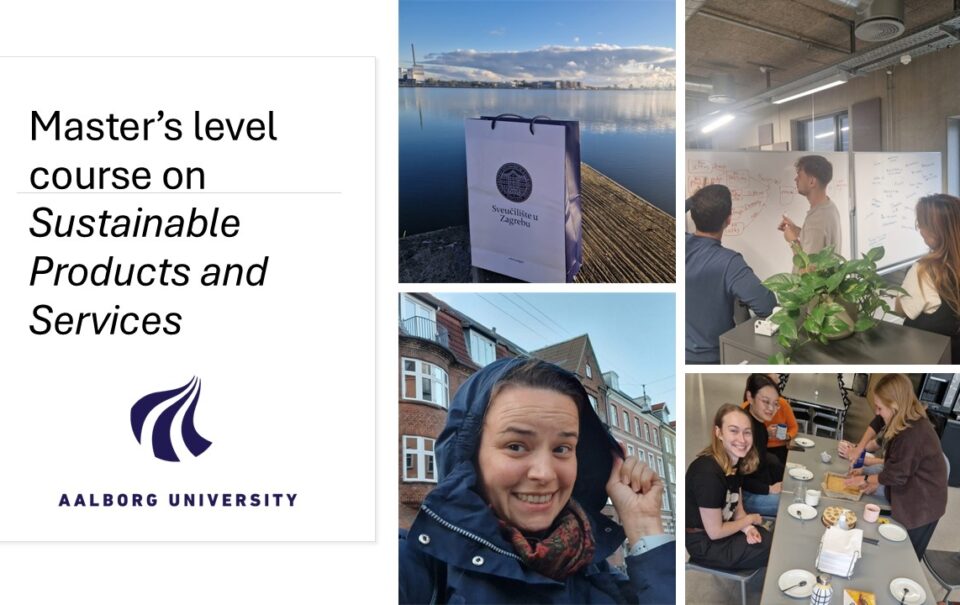
The primary purpose of the visit was to attend the master’s-level course Sustainable Products and Services and gain insights into Aalborg University’s approach to integrating sustainability into engineering education, with a particular focus on project-based learning.
Participation in the course provided an opportunity to explore innovative teaching practices and approaches that connect engineering knowledge with real-world sustainability challenges. The experience also offered valuable perspectives on how sustainability principles can be embedded in engineering curricula and incorporated into student-centred, project-based learning activities.
In parallel with the educational activities, the mobility aimed to initiate research collaboration on a life cycle assessment (LCA) study of the pilot-scale electrification of clay calcination for cement production. This process had previously been tested at UNIZG-FCE, providing a basis for further investigation into its environmental performance and potential contribution to decarbonising cement production. The planned collaboration focuses on quantifying environmental impacts and developing a conceptual framework for assessing electrification as a potential net-zero technology for the production of construction materials.
A key outcome of the mobility was the preparation of a draft research article entitled “Net-Zero Carbon Calcined Clay Production – A Prototype Case Study of Electrified Rotary Clay Calcination for LC3 Production”. The article examines the potential of electrified rotary clay calcination for producing limestone calcined clay cement (LC3), a promising alternative to conventional cement that can help reduce the carbon footprint of cement production. The work establishes a foundation for further research into the environmental benefits, challenges and decarbonisation potential of electrified clay calcination.
Overall, the mobility strengthened the foundations for future research cooperation between the University of Zagreb and Aalborg University, combining knowledge exchange in sustainable engineering education with joint research on low-carbon construction materials and life cycle assessment. The visit also supported the development of international academic networks and interdisciplinary approaches to addressing sustainability challenges in the construction sector. Through these activities, the mobility contributed to both the advancement of research on net-zero technologies and the exchange of good practices in engineering education, supporting ongoing efforts towards a more sustainable and climate-neutral built environment.